Improving Platform Channel Performance in Flutter
Over the past couple of years, I’ve been interested in the problem of “How do we make communication between Flutter and its host platform…


Over the past couple of years, I’ve been interested in the problem of “How do we make communication between Flutter and its host platform faster and easier?” This is a question of particular interest to Flutter plugin developers and add-to-app developers.
Communication between Flutter and the host platform is typically done with platform channels, so my energy has been focused there. In late 2019, to remedy the amount of boilerplate and
stringly typed code required to use platform channels, I designed a
codegen package, Pigeon, that makes platform channels type-safe, and the team continues to improve it. In spring 2020, I performed an
audit of platform channel and foreign function interface (FFI) performance. Now, I’ve set my sights on
improving the performance
of platform channels. Because Pigeon is built on top of platform channels, and I plan to build a data synchronization solution
for multiple Flutter instances on top of Pigeon, this is a good opportunity to help with the many different needs of developers and with my initiatives.
After some investigation, I was able to identify superfluous copies of the data being sent over platform channels and was able to remove them. Below you’ll find the results of that change and an overview of the work that lead to identifying and removing the copies.
Results
After removing the superfluous copies when sending 1 MB of binary data from Flutter to the host platform with a 1 MB response, we saw an approximately
42% increase in performance on iOS. On Android, the results were a bit more nuanced. Our automated performance tests
improved approximately 15%
while local testing saw an approximately 52% increase
when migrating to the new BinaryCodec.INSTANCE_DIRECT
codec. This discrepancy might be because the automated performance tests are running on an older device, but the discrepancy could be an artifact of how the microbenchmarks, in particular, perform on an older device (for example, hammering the garbage collector). You can find the automated performance test’s source code at
platform_channels_benchmarks/lib/main.dart.
For platform channels that use the StandardMessageCodec, I saw less of a performance gain (approximately
5% with a 14k payload). I tested it with a large array of supported types to stress test the encoding and decoding. What I found was that the encoding and decoding time of
MessageCodecs dwarfed the time spent copying the messages between platforms. Most of this encoding time is because of the cost of recursing through a data structure and using reflection to figure out what its contents are.
So, your mileage might vary depending on how you use platform channels and your device. If you want the fastest communication with platform channels, then you should use
BasicMessageChannels with the FlutterBinaryCodec
on iOS and BinaryCodec.INSTANCE_DIRECT
on Android, and develop your own protocol for encoding and decoding messages that doesn’t rely on reflection. (Implementing a new
MessageCodec might be cleaner.)
If you want to play with the new faster platform channels, they’re now available on the master channel.
Copy removal in detail
If you aren’t interested in a deep dive of how I achieved these results, and the issues I had to overcome, stop reading now. If you enjoy understanding the details, read on.
The platform channels API hasn’t changed much since 2017. Because the platform channels are fundamental to engine and plugin operation, they aren’t easy to change. While I had a general idea about how platform channels operate, they are somewhat intricate. So, the first step to improving their performance was to understand exactly what they do.
The following diagram outlines the original process the framework followed when a platform channel was used to communicate with iOS from Flutter:
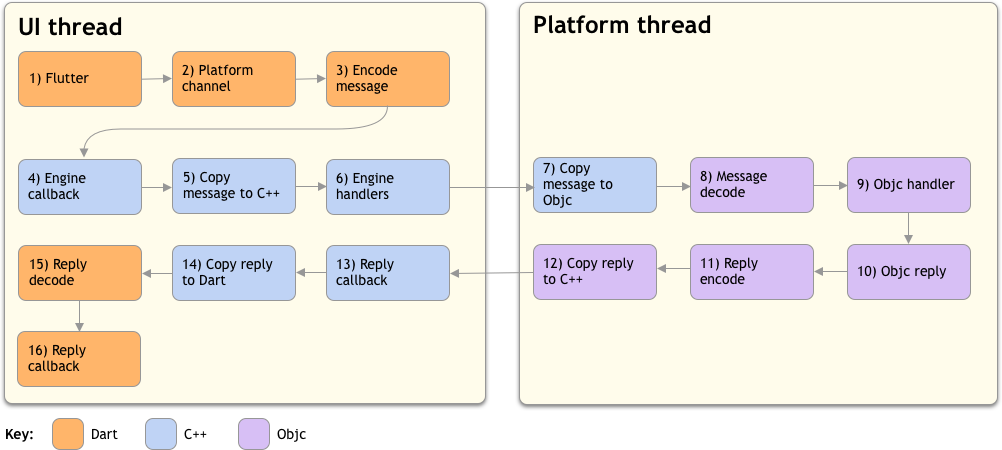
Some takeaways from the diagram:
-
The message hops from the UI thread to the platform thread and back to the UI thread. (In Flutter engine parlance, the UI thread is where Dart is executed, and the platform thread is the main thread of the host platform.)
-
The message and its response use C++ as the intermediate layer for communicating between Flutter and the host platform’s target language.
-
The message’s information was copied 4 times before reaching the Objective-C (Obj-C) handler (steps 3, 5, 7, 8). Steps 3 and 8 perform a translation, while steps 5 and 8 perform a copy, to transfer ownership of the data to a new memory layout. The same process is repeated in reverse for the reply.
Steps 1, 9, and 16 are code written by developer who use Flutter.
Sending a message from Flutter to Java/Kotlin is similar, except there is a Java Native Interface (JNI) layer between C++ and the Java Virtual Machine (JVM).
After having established how platform channels work, it became clear that eliminating the copies made when transferring data between these layers (such as from C++ to Obj-C) is an obvious method to improve performance. To achieve this, the Flutter engine would have to place the data in memory in a way that is directly accessible from Java/Obj-C and has memory management semantics which are compatible with the host platform.
The platform channel messages are ultimately consumed by the decodeMessage method of the host platform’s
MessageCodec. On Android, that means a ByteBuffer, and on iOS, that means
NSData. The data in C++ needs to conform to those interfaces. When approaching this problem, I discovered that the information of the message resided in C++ memory as a
std::vector
inside a PlatformMessage object that was maintained by a shared pointer. This means that developers couldn’t safely remove the copy when sending the data from C++ to the host platform because they didn’t have a guarantee that the data wouldn’t be mutated by C++ after it was handed over to the host platform. Furthermore, I had to be careful because the
BinaryCodec implementations treated encodeMessage and decodeMessage
as a no-op, which could lead to code using BinaryCodec unwittingly receiving a direct ByteBuffer. While it’s unlikely that someone would be surprised by changes to
MessageCodec, rarely does anyone implement their own codec. Using BinaryCodecs, on the other hand, is very common.
After reading through the code, I discovered that, while the PlatformMessage was managed by a shared pointer, it was semantically a unique pointer. The intent was that only one client had access to it at a time (that wasn’t quite the case because momentarily multiple copies existed when passing the
PlatformMessage between threads, but that was just for convenience and not actually intended). That meant we could migrate from shared pointers to unique pointers, allowing us to pass the data to the host platform safely.
After migrating to unique pointers, I had to find a way to pass ownership of the information from C++ to Obj-C. (I implemented Obj-C first, and I’ll discuss Java in more detail later.) The information was stored in an
std::vector which has no way to release ownership of the underlying buffer. Your only options are to copy out the data, provide an adapter that has the
std::vector, or eliminate the use of the std::vector.
My first attempt was to subclass NSData that would std::move the std::vector
and read its data from there, thus eliminating the copy. This attempt didn’t work well because it turns out that
NSData is a class cluster
in Foundation. That means you can’t just subclass
NSData. After reading through many of Apple’s documents, it appears that their recommendation is to use composition and message forwarding to make an object behave and look like an
NSData. That would fool those who use the proxy object, except for those who call -[NSObject isKindOfClass:]. While that is unlikely, I couldn’t rule out the possibility. Although I think there might have been some fiddling with the Obj-C runtime that could have made the object behave the way I wanted, it was getting complicated. I instead opted to move the memory out of
std::vector and into our own buffer class
that allows releasing ownership of the data. That way, I could use -[NSData dataWithBytesNoCopy:length:]
to transfer ownership of the data to Obj-C.
Duplicating this process on Android proved a bit more difficult. On Android, platform channels conform to
ByteBuffer that has the concept of direct ByteBuffers, which allow Java code to interface directly with memory that is laid out in C/C++ style. In a short time, I implemented the move to direct
ByteBuffers, but I didn’t see the improvement that I expected. I spent a lot of time learning Android profiling tools, and I eventually opted for trace statements when those failed or returned things I couldn’t believe. It turned out that scheduling the reply to the platform channel message on the UI thread from the platform thread was massively slow, and it seemed to be slow in such a way that the slowdown scaled with the payload of the message. Long story short, I was compiling the Dart VM with the incorrect compilation flags, thinking — no-optimization meant no
link-time optimization, but the flag was actually for runtime optimization.
In my excitement at having found my blunder, I forgot about the ramifications of using a direct ByteBuffer
when sending the data into Flutter client code, specifically through custom MessageCodecs or clients of
BinaryCodec. Sending a direct ByteBuffer means you have a Java object that is communicating with C/C++ memory, so if you delete the C/C++ memory, then Java interacts with random garbage and will probably crash with an access violation from the operating system.
Following the example of iOS, I attempted to pass ownership of the C/C++ memory to Java, such that it deletes the C/C++ memory when the Java object is garbage collected. It turns out that doing this isn’t possible when the direct
ByteBuffer is created from the JNI through NewDirectByteBuffer. JNI provides no hook to know when a Java object is deleted. You can’t subclass
ByteBuffer so that it calls the JNI when it’s finalized. The only hope would be to allocate the direct
ByteBuffer from the Java API at step 5 in the preceding diagram. Direct ByteBuffers that are allocated through Java don’t have this limitation. Introducing a new entry-point into Java however would have been a massive change, and anyone who has worked with JNI knows that it’s perilous.
Instead, I opted to petition the team to accept direct ByteBuffers in decodeMessage
calls. At first, I introduced a new method to MessageCodec, bool wantsDirectByteBufferForDecoding(), to make sure no one got a direct
ByteBuffer unless they asked for it and knew the semantics of them (that is, when the underlying C/C++ memory is still valid). That proved to be complicated, and the worry was that developers might still subscribe and not know the semantics of the direct
ByteBuffers because they operate contrary to typical ByteBuffers, and might have had their C memory backing deleted underneath them. Storing the encoded buffers was atypical usage on top of unlikely usage, but the team couldn’t rule it out. After many discussions and negotiations, we decided that every
MessageCodec gets a direct ByteBuffer that is cleared out after decodeMessage
is called. That way, if someone caches encoded messages, then they’ll get a deterministic and apropos error in Java if they try to use the
ByteBuffer after the underlying C memory is cleaned up.
Giving everyone access to the performance gains of direct ByteBuffers worked great, but was a breaking change to
BinaryCodec whose encodeMessage and decodeMessage implementations are no-ops, they just forward their input as their return value. To keep the same memory semantics for
BinaryCodec, I introduced a new instance variable
that controls whether the decoded message is a direct ByteBuffer (new, faster code) or a standard
ByteBuffer (old, slower code). We couldn’t create a way to give the performance speed up to all clients of
BinaryCodec.
Future work
Now that eliminating the copies is done, my next efforts to improve communication between Flutter and the host platform will be:
-
Implement a custom
MessageCodecfor Pigeon that doesn’t rely on reflection for faster encoding and decoding. -
Implement FFI platform channels that allow you to call from Dart to the host platform without hopping between the UI and the platform thread.
I hope you enjoyed this deep dive into the details of this performance improvement!
More from Flutter

Flutter Q2 survey
Just a reminder! Please take the Flutter Q2 survey! The survey closes at the end of day on Friday, June 19th.

Announcing our new Dart and Flutter Getting Started experience
When I joined the Dash DevRel team, my manager gave me an onboarding doc which started like this: “Your new job in one sentence: Improve…